Send a Sukkot Gift to Israel 2026 — Dates & Harvest Boxes
Sending a Sukkot gift to Israel means sending a harvest-season box — honey, olive oil, wine, dried fruit and nuts — to family, friends, employees or clients for the Feast of Tabernacles, delivered from inside Israel so nobody pays customs or import VAT. Sukkot 2026 runs from sundown on Friday, 25 September to nightfall on Friday, 2 October, and it is the festival of the ingathering (Chag HaAsif), which is why a gift drawn from the land itself lands so well. At Hibuk Otef every box is built from named Israeli producers in the south and north, so the gift also supports the farm or workshop behind it — the same principle we set out in our guide to Israeli gifts that support real producers.
Hibuk Otef — The Story Behind Every Gift
Hibuk Otef (“Enveloping Embrace”) is a unique boutique gift initiative that brings together products from the communities of the Gaza Envelope and Israel’s southern and northern frontier, alongside works of art that commemorate the beauty of the region. The project was founded to support local producers, farmers and entrepreneurs who were affected. 60% of revenues go directly to producers from the affected communities.
When Is Sukkot 2026 — and the Last Day to Order
The dates: Sukkot 5787 begins at sundown on Friday, 25 September 2026. In Israel the first festival day is Saturday, 26 September; the intermediate days (chol hamoed) run through Hoshana Rabbah on Friday, 2 October; and Shemini Atzeret and Simchat Torah — one combined day in Israel, two in the Diaspora — fall on Saturday, 3 October. That makes a nine-day stretch in which almost nothing moves.
Order by 14 September for a single address, and by 9 September for multi-address or bulk corporate orders. Those are not padded dates. Nationwide delivery inside Israel takes about 3–8 days depending on the destination, and the Tishrei calendar removes most of the runway (see the next section). If you are planning the whole autumn wave rather than one gift, our Rosh Hashanah gift guide covers the earlier holiday and our Jewish-holiday gifting calendar maps the full year.
Why Sukkot Is the Hardest Israeli Holiday to Ship For
Seven business days. That is the whole window. Israel's working week runs Sunday to Thursday, and in 2026 the Tishrei holidays eat almost all of it. Rosh Hashanah closes the country from Friday 11 September to Sunday 13 September. That leaves Monday 14 to Thursday 17 September — four working days. Then Sunday 20 September is erev Yom Kippur, effectively a half day, and on Monday 21 September the entire country stops for 25 hours. That leaves Tuesday 22 to Thursday 24 September — three more working days. Friday 25 September is erev Sukkot.
Four plus three is seven. Every courier, packer and producer in the country is trying to clear a month of orders through those seven days, which is why deliveries that normally take three days can take eight in late September. The practical rule: an order placed in the first half of September ships comfortably; an order placed after 17 September is a gamble.
- Last comfortable order date, single address: Monday 14 September
- Last realistic order date, single address: Wednesday 16 September
- Multi-address and bulk corporate orders: Wednesday 9 September
What Makes a Great Sukkot Gift
Start with the harvest, then think about the table. Sukkot is the ingathering festival, so the gifts that feel right are the ones that come off the land — honey, extra-virgin olive oil, dried fruit, roasted nuts, boutique wine. But the second half of the holiday is hospitality. Families eat every meal for seven days in a sukkah, and the ushpizin tradition — recorded in the Zohar in Aramaic, where ushpizin simply means “guests” — invites seven symbolic visitors across the seven nights: Abraham, Isaac, Jacob, Moses, Aaron, Joseph and David. The classical reading of that custom is blunt: welcoming the symbolic guest only counts if you also welcome a real one.
So a Sukkot gift has two jobs. It should taste of the season, and it should be something the recipient can put on a table other people will sit around. That is why our Sukkot boxes lean toward shareable formats — a bottle, a board of nuts and dried fruit, a chocolate bar big enough to break up — rather than a single personal treat.
Give a gift that gives back: every box below is assembled from producers in the Gaza Envelope, the Negev and the northern border communities, many of them farming families who lost a season or more. Choosing a harvest gift from these growers turns a holiday courtesy into direct income — the mechanics are set out in our page on how gifts reach Israeli farmers in the south and north.
Choose Your Sukkot Gift by Budget
Prices below are per box and include 18% VAT, the rate confirmed in the 2026 budget. The range runs ₪77 to ₪295 (roughly $26 to $99 at about 2.98 shekels to the dollar). Every box is kosher, ships anywhere in Israel, and there is no minimum order on any of the five — order one or order eighty. All five were verified in stock at the time of writing.
Shaked Box — ₪77
The connection to Sukkot: the harvest in miniature. Cold-pressed extra-virgin olive oil from the Otef or Galilee groves (250 ml) — or, as an alternative, a 250 ml pomegranate liqueur or limoncello — plus 250 g of Upper Galilee honey (or a preservative-free strawberry, pear-in-wine or rose confiture) and a pack of date-and-nut bars with no added sugar. Oil, honey, dates: three of the seven species, in one small designed box. The right gift for a “chag sameach” to a colleague, a neighbour or a friend's sukkah. View the Shaked box.
Autumn Embrace — ₪112
The connection to Sukkot: something to open at the table. A 120 g handmade chocolate bar — milk chocolate with nuts and Galilee honey — a 190 g preservative-free basil-and-cashew pesto (its purchase includes a donation to the security forces), a preservative-free berry or strawberry confiture, and the Cooking Together recipe book, 72 pages honouring the farmers of the Gaza Envelope and printed at Beeri Print on Kibbutz Be'eri. A natural-cotton Hibuk Otef tote (38×42 cm) can stand in for the pesto. View the Autumn Embrace box.
Autumn Indulgence — ₪142
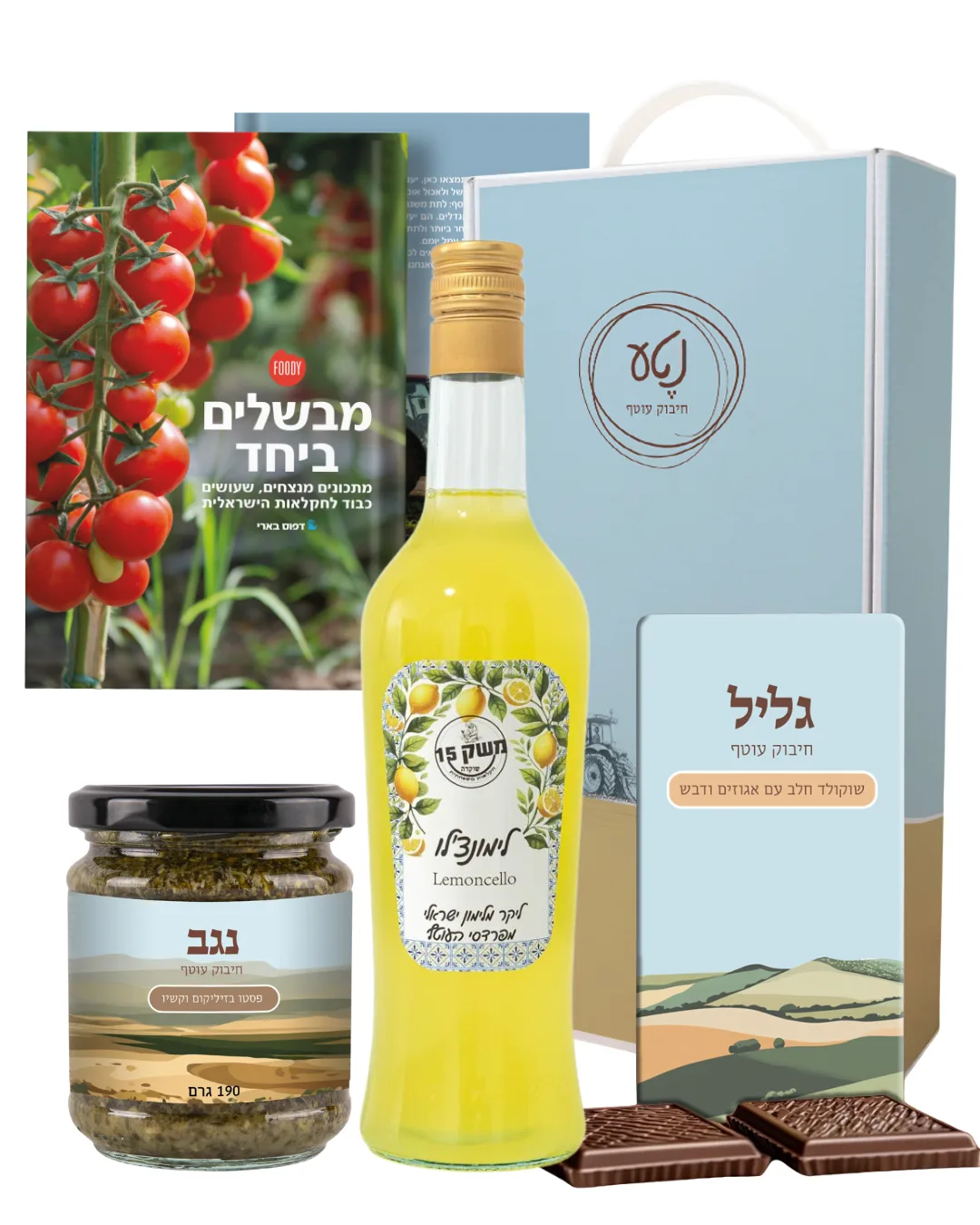
The connection to Sukkot: light and sweetness for seven evenings outdoors. Six handmade pralines in assorted flavours — or a 700 ml bottle of limoncello or rimoncello pressed from fruit grown in the Otef vineyards — together with a scented candle from the Naarei HaOr farm, cast in a glass jar under a jute cover, plus the Cooking Together recipe book and either a cotton tote or the basil-cashew pesto. A sukkah is lit and eaten in after dark; this is the box built for that. View the Autumn Indulgence box.
Family Embrace — ₪177
The connection to Sukkot: it is designed around guests. Inside a decorated 18×35×10 cm box with a handle: the Hibuk Otef family card game — 24 cards of questions and prompts made to open up conversation around a table — a framed-quality art print (15×20 cm, 300 gsm woodfree paper) from the Zikaron Otef project of the Bezalel Academy of Arts and Design in Jerusalem, a 100 g mix of low-heat-dried Israeli fruit (mango, persimmon, apple, banana, blueberry), 200 g of roasted cashews, pecans, hazelnuts, macadamias, pistachios and almonds, 50 g of chocolate-coated nuts and two date-and-nut energy bars. Twenty-four conversation cards and seven nights of ushpizin is a good ratio. View the Family Embrace box.
Family Premium — ₪295
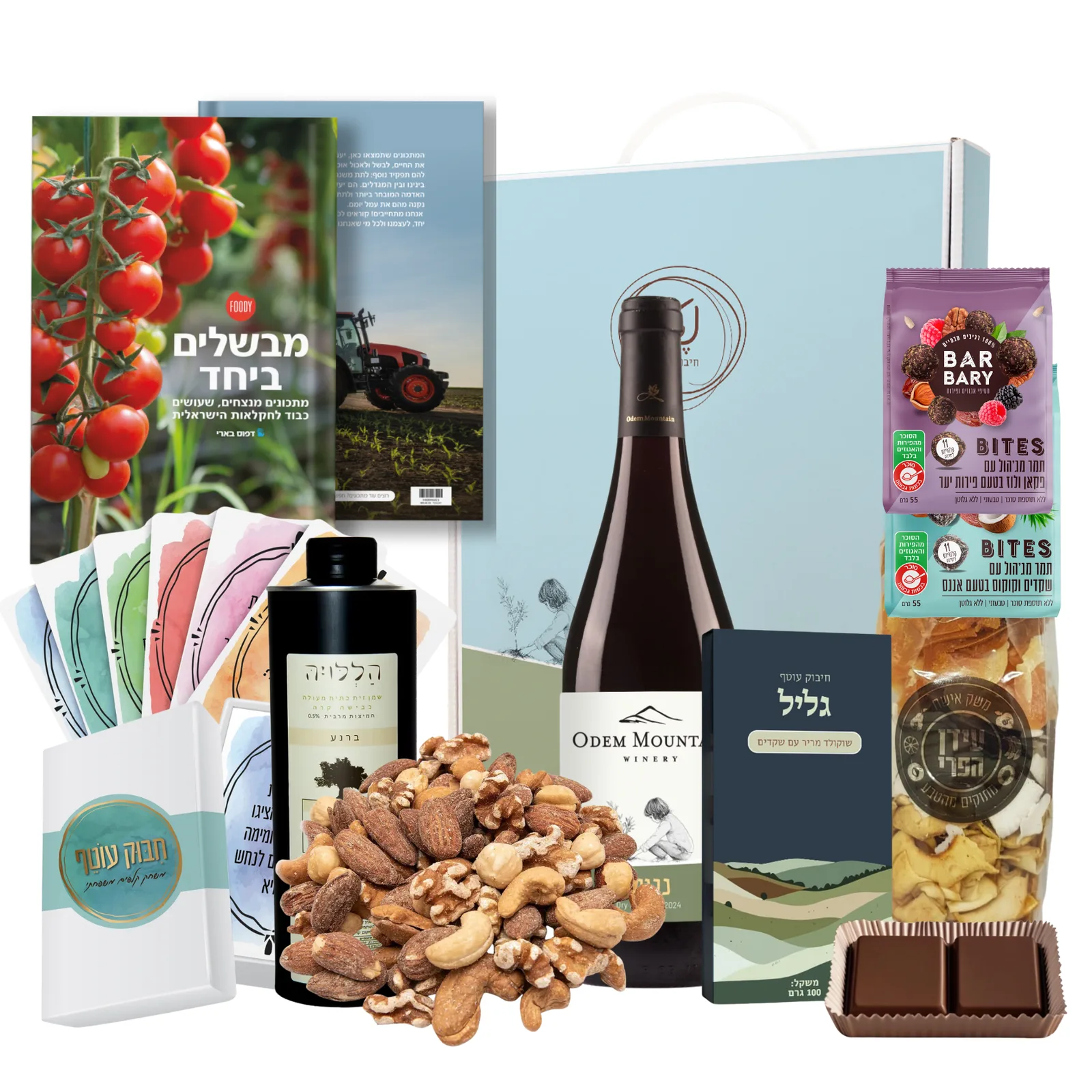
The connection to Sukkot: the box you send when the whole sukkah is eating from it. A 750 ml bottle of “Alma” boutique red from Har Odem Winery on the Golan — Cabernet Franc, Cabernet Sauvignon and Syrah — 250 ml of cold-pressed extra-virgin olive oil from the Otef or Galilee groves, a 100 g handmade chocolate bar (dark with almonds, or milk with honey and hazelnut), the dried-fruit mix, the 200 g six-nut roast, two energy bars, the family card game, and the Cooking Together recipe book from Beeri Print. Presented in a 26×35×10 cm box with a handle. View the Family Premium box.
Want a different price point or a themed variation? Ask us — we build to a brief.
Sending to a Sukkah You Won't Sit In
The most common Sukkot order we receive is from someone 9,000 km away. A child studying in Jerusalem, a sibling in Haifa, an Israeli team of thirty spread across five cities. Three things make that easier. First, we ship domestically, so the recipient never sees a customs form, a broker fee or an import VAT bill — the sort of charge that applies to parcels sent from abroad once they pass Israel's personal-import exemption, which was lowered back to $75 on 2 June 2026. Second, we can split one order across many addresses, which is why multi-address orders need the earlier cut-off: each address is a separate dispatch through the same seven-day window. Third, a handwritten greeting or a branded card goes in at no charge, so the box arrives sounding like you.
One practical note for chol hamoed: many Israeli families travel during the intermediate days, 27 September to 1 October. If your recipient is likely to be away, aim the delivery at the days before the holiday rather than during it. A box that arrives on 23 September gets used all week. A box that arrives on 29 September may sit at a neighbour's.
Simchat Torah 2026 and What Sukkot Closes On
Sukkot 2026 ends on Saturday, 3 October — Shemini Atzeret and Simchat Torah, marked as one day in Israel. That date carries a second weight. The Hamas attack of 7 October 2023 fell on Simchat Torah 5784, so by the Hebrew calendar the anniversary of that day is Simchat Torah, not 7 October. In 2026 that anniversary is 3 October, the closing day of the very holiday this article is about.
For many of the communities we buy from — Be'eri, Shokeda, the moshavim along the northern border — that overlap is not abstract. It is why our boxes carry a recipe book printed at Beeri Print rather than a generic one, and art from the Zikaron Otef project rather than stock imagery. A gift sent for Sukkot 2026 is a gift sent into that week. Our page on gifts that support October 7 survivors in the south and north explains where the money lands.
The Producers Behind Every Sukkot Box
Named makers, not anonymous stock. Every producer below appears in at least one of the five boxes above — we do not attach a story to a box that does not contain that maker's work.
Har Odem Winery (Golan Heights, north): a family winery on the volcanic slopes of Mount Odem, about 1,000 metres up, where cold nights and basalt soil give the fruit its structure. Their “Alma” red — a Cabernet Franc, Cabernet Sauvignon and Syrah blend — is the bottle in the Family Premium box. The Golan wineries spent much of 2023–2024 working under rocket fire and evacuation orders from the Lebanon front, and a bottle sold is a season defended.
Beeri Print (Kibbutz Be'eri, Gaza Envelope): one of Israel's oldest and largest printing houses, and part of the kibbutz that lost more than a hundred members on 7 October 2023. The press has since returned to work. It prints the 72-page Cooking Together recipe book that appears in three of the boxes above — a book of recipes from the farmers of the Otef, made by the printers of the Otef.
Naarei HaOr farm (Reshafon): a small candle and ceramics workshop whose scented candles are hand-cast into glass jars finished with a jute cover. Theirs is the candle in the Autumn Indulgence box, and a lit candle on a sukkah table on the fourth night is roughly the entire point of the holiday.
*Bezalel Academy of Arts and Design (Jerusalem) — the Zikaron Otef project:* student and graduate artists documenting the landscapes of the Gaza Envelope, printed at 15×20 cm on 300 gsm woodfree paper. The print in the Family Embrace box comes from that series. It is the piece of the box that stays on a wall long after the dried fruit is gone — and you can read more in our note on Israeli art that supports the Otef.
Kosher, Customs and Delivery — What to Know
Kosher and local, which solves most problems at once. Every box is kosher under local rabbinate supervision, most items Badatz, and we can match a stricter or specific kashrut standard on request — say so when you order and we will build to it. Because we pack and ship from inside Israel, your recipient pays no customs duty, no broker fee and no import VAT; the parcel never crosses a border. Nationwide delivery runs about 3–8 days depending on destination, with the northern and southern peripheries at the longer end, and there is a flat delivery charge added at checkout rather than buried in the box price.
We deliver to homes, offices, kibbutzim, army bases and student dormitories, to one address or to hundreds. Alcohol-free boxes are available across the range if the recipient does not drink — the Shaked and Family Embrace boxes above already qualify. Full details on the international side are in our guide to sending gifts to Israel without customs or duties.
Frequently Asked Questions
When is Sukkot 2026, and when should I order?
Sukkot 2026 begins at sundown on Friday, 25 September and ends at nightfall on Friday, 2 October, with Shemini Atzeret and Simchat Torah on Saturday, 3 October. Order by 14 September for a single address and by 9 September for multi-address or bulk corporate orders. There are only seven Israeli business days between the end of Rosh Hashanah and erev Sukkot, so later orders are genuinely at risk.
Are your Sukkot gift boxes kosher?
Yes. Every box is kosher under local rabbinate supervision, and most items carry Badatz certification. If your recipient keeps a specific standard, tell us when you order and we will build the box to match rather than guess.
Will my recipient in Israel pay customs or import VAT?
No. We pack and ship from within Israel, so nothing crosses a border and no customs, duty or import VAT applies. That is the main practical difference from sending a parcel yourself from abroad, where Israel's personal-import exemption has been back down at $75 since 2 June 2026.
Can I send Sukkot gifts to several addresses at once?
Yes. We handle both a consolidated delivery to one point and individual shipments to employees, clients, family and friends across the country. Multi-address orders need the earlier cut-off — 9 September for Sukkot 2026 — because each address is a separate dispatch through the same narrow window.
Do you offer alcohol-free, vegan or gluten-free Sukkot boxes?
Yes. Several boxes are alcohol-free as standard, including the Shaked and Family Embrace boxes above, and we can build gluten-free or vegan versions on request. Tell us the requirement when you order and we will confirm exactly what goes in before we pack.
How to Order
Ready to send a Sukkot gift to Israel? Order on our website, message us on WhatsApp (054-2207955), or email netalc24@gmail.com, and we will tailor a box to your budget, your quantity and your recipient's kashrut. For Sukkot 2026 the working cut-offs are 14 September (single address) and 9 September (multi-address).
Written by Neta Lin Cohen — founder of Hibuk Otef, architect and Bezalel graduate, with 30+ years of experience in culinary gifting.