Send a Get-Well Gift to Israel — Ward-Safe Kosher Boxes
A get-well gift to Israel is a kosher, shelf-stable comfort box sent to someone recovering from illness, surgery or a hard stretch — packed and delivered inside Israel, so there is no customs form and nothing for the recipient to pay. In Hebrew the wish is refuah shlema, a full and complete recovery. This guide covers what recovering people can actually receive (hospital wards refuse more than most senders realise), how to check a box for alcohol before you send it to someone on medication, honest delivery timing, and five boxes from ₪54 to ₪177. If you want the wider picture first, start with our guide to Israeli gift boxes that support real producers.
Hibuk Otef — The Story Behind Every Gift
Hibuk Otef ("Enveloping Embrace") is a unique boutique gift initiative that brings together products from the communities of the Gaza Envelope and Israel's southern and northern frontier, alongside works of art that commemorate the beauty of the region. The project was founded to support local producers, farmers and entrepreneurs who were affected. 60% of revenues go directly to producers from the affected communities.
What Recovering People Can Actually Receive
The two most popular get-well gifts — fresh flowers and a fresh fruit basket — are the two most likely to be turned away at the ward door. Oncology, intensive-care and transplant units commonly operate a blanket "no live plants" rule, because soil, standing vase water and decaying plant matter carry mould, fungal spores and water-borne organisms that are harmless to a healthy visitor and dangerous to someone immunosuppressed. Fresh fruit is a separate question: for transplant and cellular-therapy patients, clinicians ask that you check with the medical team before sending any fresh produce at all. A sealed, shelf-stable food box sidesteps both problems. Nothing needs water, nothing rots on the windowsill, and the shelf life on most items here is at least 6 months — so a box that arrives during a six-week recovery is still good at the end of it. Practical, not decorative, is the rule.
What travels well to a bedside: honey, fruit conserve, granola, olive oil, date-and-nut bars with no added sugar, dried fruit, a good chocolate bar. What does not: anything that needs refrigeration, anything in a vase, and anything that assumes a full appetite.
Check the Box for Alcohol Before You Send It
This is the single most-skipped check in get-well gifting, and it matters more here than at any other occasion. Someone recovering is very often on medication that does not mix with alcohol: NSAIDs such as ibuprofen raise the risk of stomach bleeding when combined with it, paracetamol plus regular drinking risks liver damage, prescription opioids combined with alcohol can cause dangerously slow breathing, and certain antibiotics — metronidazole is the classic — react badly enough that guidance is to wait around 72 hours after the last dose. Alcohol also slows healing after an infection. Yet a large share of Israeli gift boxes quietly include a 700ml liqueur or a 750ml bottle of wine, sometimes as an "or alternatively" substitution buried in the packing list rather than in the box title.
Every one of the five boxes below is alcohol-free, checked line by line against the live packing list rather than against a product flag — in our own catalogue census this week, 90 of 147 in-stock boxes name wine or liqueur in their description while only 41 carry the alcohol flag, so the flag alone is not a safe check. If you are buying elsewhere, read the full contents list, not the title. One more reason to look: alcohol is excluded from Israel's $75 personal-import exemption, so a single bottle in an overseas parcel can void the recipient's duty-free allowance.
Choose Your Get-Well Box by Budget
Prices below are VAT-inclusive, as shown to private senders, and run from ₪54 to ₪177 (roughly $18 to $59 at about ₪3 to the dollar). Home, business or hospital delivery anywhere in Israel is a flat ₪53.10 including VAT; self-collection from our packing room at Arbel 1, Shilat Industrial Zone is free. Every box is kosher under local rabbinate supervision, most Badatz, and every contents list below is transcribed from the live product page.
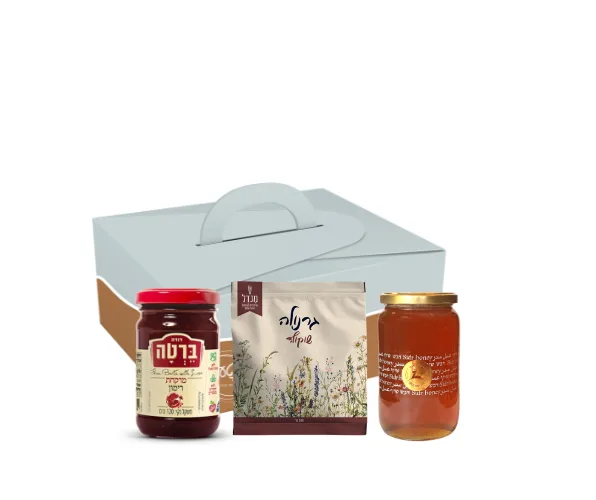
Hila Box — ₪54.28
The lightest sensible get-well gift we make, and the one that best suits someone eating very little: Upper Galilee honey (130g), a preservative-free fruit conserve (120g), and a whole-oat granola (200g) in a choice of halva-date, raisin-and-nut, apple-and-honey or chocolate. Breakfast in a box for a person who is not cooking. See the Hila box.
Naama "Attention" Box — ₪70.80
A step up in indulgence without being rich: a handmade chocolate bar (80g) in dark-with-candied-pecan or milk-with-hazelnut, a preservative-free conserve (240g) in blueberry, apple-cinnamon or pomegranate, and a date, nut and fruit bar with no added sugar (55g). The no-added-sugar bar is the detail worth knowing if the recipient has been told to watch sugar during recovery. See the Naama box.
Yarden Box — ₪94.40
The keepsake tier. Alongside Upper Galilee honey (200g) and a no-added-sugar date-and-nut bar (45g), this box holds a designed acrylic honey vessel with a cork lid and spoon, created by a pair of women artists from Studio Dugma in the Gaza Envelope. The jar stays on the kitchen counter long after the honey is gone — which is often the point of a recovery gift. See the Yarden box.
Adir Box — ₪129.80
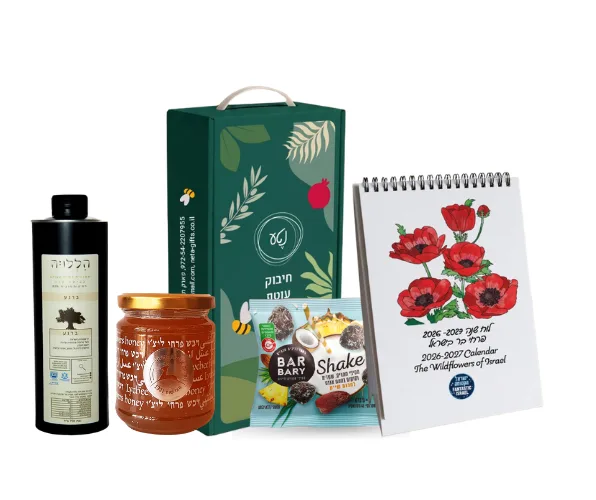
Our pick for a long recovery, because it gives the person something to look at as well as something to eat: a desk or wall calendar illustrated with the wildflowers of the Land of Israel by the artist Tali Matar (18×23cm, and the calendar carries a donation to the Oz La'Otef association), Upper Galilee honey (200g), cold-pressed extra-virgin olive oil from Gaza Envelope groves (250ml), and a no-added-sugar date-and-nut bar (45g). See the Adir box.
Family Embrace Box — ₪177.00
For a household absorbing a long illness, not just the patient. It carries a "Hibuk Otef" card game of 24 task and question cards designed to encourage open, supportive conversation between participants; a selected art print of the Gaza Envelope landscape from the "Zikaron Otef" project of the Bezalel Academy of Art and Design, Jerusalem (15×20cm on 300gsm wood-free paper); an Israeli dried-fruit mix dried at low heat to preserve its nutritional value (mango, persimmon, apple, banana, blueberry, 100g); a roasted nut mix (200g); chocolate-coated nuts (50g); and two no-added-sugar energy bars. See the Family Embrace box.
The Producers Behind These Boxes
Three named makers appear in the 5 boxes above, and we name a producer only when that producer's item appears on the live packing list — 60% of revenue goes directly to producers from the affected communities, so who is actually in the box is not a decorative detail. Where an item is sourced by region rather than from a single named farm — the Upper Galilee honey and the Gaza Envelope olive oil in these boxes — we say so plainly instead of inventing a farm name, which is a habit worth demanding from any gift company that tells you it supports named makers.
Studio Dugma (Gaza Envelope). A pair of women artists in the Otef who design the acrylic honey vessel in the Yarden box — cork lid, matching spoon, 90×65mm. It is the kind of small, useful, made-nearby object that survives the recovery and keeps working afterwards.
Tali Matar (Gaza Envelope). The illustrator behind the wildflower calendar in the Adir box, drawing the wild flora of the Land of Israel month by month. The calendar carries a donation to the Oz La'Otef association alongside the purchase, so the art item does a second job.
Bezalel Academy of Art and Design, Jerusalem — "Zikaron Otef". The Visual Communication department's project produces art prints of the Gaza Envelope landscape; one selected print sits in the Family Embrace box, printed on 300gsm wood-free paper. It is the piece that turns a food box into something that goes on a wall. You can read more in our guide to the makers behind every box.
Delivery Timing — The Honest Numbers
Here is the part most gift sites round in their own favour. Our stated delivery estimate is 4–8 business days, on a Sunday-to-Thursday courier week. That is slower than the Israeli competitors advertising 24–36 hours or next-day delivery, and if the person needs something today, the right answer is to order locally near them — we would rather say that than quietly miss the date. Where a slower box wins is the week after: the flowers have wilted and the visitors have thinned out, and that is exactly when a shelf-stable box arriving feels like being remembered twice.
Count the calendar, not just the days. Ordering on a Thursday pushes the clock past the weekend before it starts. And the autumn holidays remove delivery days outright: Yom Kippur falls on Monday 21 September 2026 (from sundown Sunday 20 September), the first day of Sukkot on Saturday 26 September (from sundown Friday 25 September), and Shmini Atzeret / Simchat Torah on Saturday 3 October. Between 20 September and 4 October, add three to four days to any estimate. Sending from abroad to an address outside Israel is a different route — typically up to 15 days, or up to 7 for paid express.
When Should It Arrive? What Bikur Cholim Suggests
Jewish tradition has unusually specific guidance on timing a visit to someone ill, and it transfers neatly to timing a gift. Bikur cholim — visiting the sick — is treated as a mitzvah in its own right, and the classical guidance is to avoid the first 3 hours and the last 3 hours of the day, favouring the middle 6: early on, a patient can look better than they are; late on, they are too tired to receive anyone. Family and close friends may come immediately, while others traditionally wait until 3 days have passed. Rav Chaim's often-cited calculation puts a good visit at around 6 minutes — the point is presence, not duration.
Applied to a box: a gift that lands on day five or six is not late. It arrives roughly when the tradition says the wider circle should be showing up, and after the first crowded days when the household has more flowers than vases. If you want it to coincide with a visit, order about ten days ahead and add the holiday gaps above.
Frequently Asked Questions
Are your get-well gift boxes kosher?
Yes — every box is kosher under local rabbinate supervision, and most carry Badatz certification. We can also match specific kashrut requirements on request, so a box is safe to send to an observant home or a hospital ward.
Can I send a get-well box without alcohol?
Yes, and for a recovering recipient you should. Many boxes contain no alcohol at all — all five above are alcohol-free, verified against the packing list — and any box can be built alcohol-free, gluten-free or vegan if you tell us when you order.
How long does delivery to a home or hospital in Israel take?
The estimate is 4–8 business days on a Sunday-to-Thursday courier week, anywhere in Israel. Home, business or hospital delivery is a flat ₪53.10 including VAT, and the courier calls ahead to coordinate handover if the recipient is resting or has moved wards. Collection from Shilat is free.
Will the food still be good if the recovery is long?
Yes. Most items have a shelf life of at least 6 months, and nothing in these boxes needs refrigeration, so a box can sit unopened for weeks and still be worth opening. That is the main practical advantage over fruit or flowers.
Is there a minimum order?
No — you can order any quantity, from a single get-well box to a batch for a team or a ward, and we will tailor an offer for larger orders. Boxes can also go to several different addresses in one order.
How to Order
Order on our website, message us on WhatsApp at 054-2207955, or email netalc24@gmail.com and we will build the right box — alcohol-free, gluten-free or vegan if you need it — and get it to the door or the ward. If the occasion turns out to be a bereavement rather than a recovery, see our sympathy and care gift guide or the guide to sending food to a shiva house instead. For duty and threshold questions on overseas addresses, see how to send gifts to Israel without customs, and for kashrut detail, what "kosher" actually guarantees.
Written by Neta Lin Cohen — founder of Hibuk Otef, architect and Bezalel graduate, with 30+ years of experience in culinary gifting.