Send Food to a Shiva House in Israel — Kosher Comfort Boxes
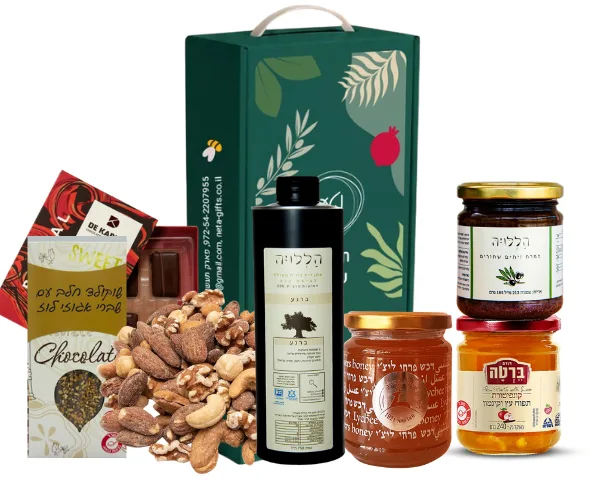
Sending food to a shiva house in Israel means sending kosher, ready-to-eat comfort that needs no cooking, no serving and no effort from the family — delivered locally, with no customs and no import delay. It answers one of the oldest obligations in Jewish mourning: the seudat havra'ah, the meal of consolation, which by law the community provides and the mourner does not prepare. If you are choosing from abroad, start with the full range of kosher Israeli gift boxes that support real producers and pick the one that fits the household.
Hibuk Otef — The Story Behind Every Gift
Hibuk Otef (“Enveloping Embrace”) is a unique boutique gift initiative that brings together products from the communities of the Gaza Envelope and Israel’s southern and northern frontier, alongside works of art that commemorate the beauty of the region. The project was founded to support local producers, farmers and entrepreneurs who were affected. 60% of revenues go directly to producers from the affected communities.
What Is the Seudat Havra'ah — and Why Someone Else Must Bring It
The seudat havra'ah is the first meal mourners eat after returning from the cemetery, and Jewish law places the duty to provide it on everyone except the mourners themselves. That single rule is why food — not flowers, not a card — is the default gesture at a shiva house in Israel. Shiva runs for seven days, counted from the day of burial, and ends on the morning of the seventh day straight after the morning service, so a part-day at each end counts as a full day. The classic foods of the meal are round — hard-boiled eggs, lentils, round bread — read as the unbroken cycle of life, and the lentil, which has no mouth, is taken to echo the silence of grief. A box of shelf-stable food carries the same intention across any distance: it feeds the household and the stream of visitors without asking the family to cook, shop or host. Every Hibuk Otef box is kosher under local rabbinate supervision, most Badatz, and 60% of what you spend goes directly to the small Israeli producers who made what is inside it.
What to Send to a Shiva House in Israel — and What Not To
Send food that can sit on a counter all day and be eaten straight from the jar; do not send flowers. Cut flowers are avoided in Jewish mourning — they wilt, and the custom leans toward simplicity — so a comfort box of honey, preserves, olive oil, dried fruit, nuts, chocolate and date bites is the appropriate substitute. Practical constraints matter more than presentation here. The house is full and then suddenly empty; meals happen at odd hours; nobody wants to assemble anything. Every item in the five boxes below is shelf-stable and ready to eat: 250 g jars of Upper Galilee honey, 240 g fruit preserves made without preservatives, 200 g roasted nut mixes, 190 g of savory spread. Nothing needs refrigeration, and nothing spoils if the family opens the box slowly across the week. Any box can also be adapted — alcohol-free, gluten-free or vegan — if you tell us when you order, which matters in an observant or mixed household.
Tishrei 2026: When a Festival Cuts the Shiva Short
In Israel right now, a shiva may be far shorter than seven days: a major festival that begins during shiva ends it immediately. For a death this month that means three fixed dates. Yom Kippur falls on Monday 21 September 2026, beginning at sundown on Sunday 20 September. Sukkot begins at sundown on Friday 25 September, with the first day on Saturday 26 September. Shmini Atzeret and Simchat Torah, kept as one day in Israel, fall on Saturday 3 October. A shiva that starts in the days before any of these is terminated when the holiday arrives — and Yom Kippur, for a shiva that has already ended, completes the thirty-day shloshim instead; after Sukkot, shloshim ends eight days after the holiday. Shabbat is different: it counts as one of the seven days, but public mourning is suspended for it. The practical consequence for you as the sender is that the crowd around a family in Tishrei can vanish overnight, days earlier than expected — which makes a box that arrives after the official mourning stops more useful, not less.
How Fast Food Actually Reaches a Shiva House in Israel
Be honest with yourself about timing: our standard delivery estimate is 4–8 business days, on a Sunday-to-Thursday courier week. Because Hibuk Otef ships from inside Israel — from the packing centre at Arbel 1 in the Shilat industrial zone, at the entrance to Modi'in — there are no customs, no import duties and no border delay, unlike a hamper sent from abroad that can take two weeks or more and can be held at the recipient's expense. Delivery anywhere in the country is ₪53.10 including VAT, the same price for one box or a carton of several, and self-pickup from Shilat is free. Between 20 September and 4 October, add three to four days: couriers do not deliver on Yom Kippur, the first day of Sukkot or Simchat Torah. If the funeral was yesterday and you need something on the table tonight, a local platter from a caterer near the family is the right call — competing services advertise one-to-three-day and next-day baskets. What a Hibuk Otef box does better is the week after, when the visitors stop coming and the house goes quiet.
Choose a Comfort Box by Budget
Every box below is kosher, shelf-stable, ready to eat and completely alcohol-free — each one checked line by line against its live packing list, because some of our festive boxes do contain a liqueur bottle and that is the wrong thing to put in a shiva house. Prices are in shekels and include 18% VAT. There is no minimum order: one box for one family, or several for a large household.
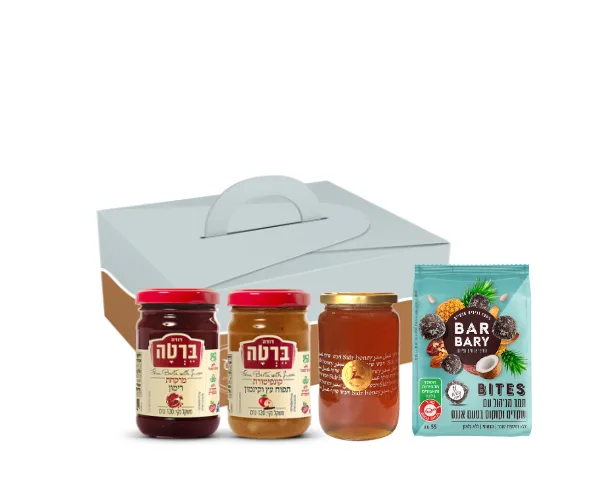
Ella Box — ₪53.10
The quietest way to say I am thinking of you. A 17×13×8 cm designed box holding one jar of fine Israeli honey from the Upper Galilee mountains (130 g), two fruit preserves made without preservatives — pomegranate, apple-and-cinnamon or blueberry (120 g) — and one pack of “Bites” date-and-nut fruit snacks with no added sugar (55 g). Small, gentle, and everything in it can be eaten with a spoon at two in the morning. See the Ella box.
Liraz “A Thought for You” Box — ₪70.80
A step up in quantity for a house that is filling with visitors: one fine fruit preserve with no added sugar — pomegranate, apple-and-cinnamon or forest berries (240 g), one jar of Upper Galilee honey (250 g), and two packs of date, nut and fruit bites with no added sugar (45 g each). The 10×35×10 cm box sits neatly on a kitchen counter without taking it over. See the Liraz box.
Dagu Box — ₪80.24
The first box with something savory in it, which matters when a family has eaten nothing but cake for three days: one bottle of Israeli extra-virgin olive oil, cold-pressed from Gaza Envelope groves (250 ml), one jar of Upper Galilee honey (250 g), and one pack of whole-oat granola — raisin-and-almond, halva-date or chocolate (200 g). Note the substitution clause on this one: the granola may instead arrive as a 45 g pack of date-and-nut bites. See the Dagu box.
Winter Embrace Box — ₪141.60
The box we would send to a household sitting shiva together, and the one with the most named makers inside it. An 18×35×10 cm box holding an aromatic candle hand-poured into a glass jar from the “Na'arei HaOr” project and the healing farm at Rishpon for trauma survivors; a handmade chocolate bar — dark with almonds, or milk with nuts and Galilee honey (100–120 g); a pack of Israeli dried fruit from the Upper Galilee mountains (100 g), or alternatively a natural cotton “Hibuk Otef” tote bag (38×42 cm); the Cooking Together recipe book, 72 pages, softcover, printed by Be'eri Press; and a jar of “Negev” basil-and-cashew pesto with no preservatives (190 g), which carries a donation to Israel's security forces. One honest note: the candle is a scented candle, not a ner neshama memorial candle — if the family wants one of those, they will have their own. See the Winter Embrace box.
Liat Box — ₪177.00
Seven items, enough to carry a full house through the week. One savory spread with no preservatives — sun-dried tomato, black olive tapenade or artichoke (185 g); one fine fruit preserve, apple-and-cinnamon or pomegranate (240 g); Gaza Envelope extra-virgin olive oil (250 ml); Upper Galilee honey (200 g); a roasted nut mix of pistachios, almonds, hazelnuts, cashews and pecans (200 g); a box of four handmade pralines; and a handmade chocolate bar — dark with cashew and cranberry, or milk with hazelnut (80 g). This is the one to choose when several relatives are staying in the house. See the Liat box.
The Makers Behind These Boxes
We name a producer only when that producer's item appears by name on the box's own live packing list. The three below are all inside the Winter Embrace box, and you can read them on the product page yourself.
Na'arei HaOr — candles, Rishpon. The aromatic candle in the Winter Embrace box is poured into a glass jar by the “Na'arei HaOr” (Youths of Light) project, tied to the healing farm at Rishpon that works with people living with trauma. Since October 2023 that farm's work has stopped being a niche concern in Israel and started being a national one. A candle is an unusually right object to arrive at a house in mourning — light, no preparation, nothing to serve.
Be'eri Press — printing, Gaza Envelope. The Cooking Together recipe book, 72 pages in softcover, is printed by Be'eri Press, the printing house of Kibbutz Be'eri in the Gaza Envelope. The book collects recipes that honour the farmers of the Envelope — the people who grow much of what is inside these boxes. It is also the one item a grieving family can put down and pick up again weeks later.
“Negev” pesto — basil and cashew, no preservatives. The 190 g jar of basil-and-cashew pesto in the Winter Embrace box is made without preservatives and carries a donation to Israel's security forces with every unit sold. It is the most practical thing in the box: stir it into pasta and a family that has not cooked in a week has dinner.
The honey, olive oil, preserves and dried fruit in the other four boxes come from Upper Galilee apiaries and Gaza Envelope olive groves, and we describe them that way rather than attaching a farm name we cannot show you on the packing list. If you want the full roster, read the producers behind every box.
Shiva Food or a Sympathy Keepsake — Which One to Send?
These are two different gestures, and the seven-day clock decides between them. Food is for the shiva itself: it discharges the seudat havra'ah obligation, feeds visitors, and needs to arrive while the house is full — or deliberately just after, for the week when nobody comes. A sympathy keepsake is for any point in the year, and it is what you send when you have missed the shiva entirely or when you want something the family keeps. If you are not sure which fits, the sympathy gift basket guide sets them side by side, and for the anniversary of a death there is a separate piece on sending a yahrzeit gift. For an observant household, it is also worth reading what kosher certification actually guarantees before you order.
Frequently Asked Questions
Is the food kosher enough to send to an observant shiva house?
Yes. Every Hibuk Otef box is kosher under local rabbinate supervision, and most items carry Badatz certification, so a box can go to an observant home without anyone having to inspect it at the door. If the family keeps a specific standard, tell us when you order and we will match the contents to it.
Should I send flowers to a shiva house in Israel instead?
No. Jewish mourning custom avoids cut flowers, and in Israel a flower delivery to a shiva house will read as a mistake rather than a kindness. Food, or a donation in the person's memory, is the expected gesture — which is why the seudat havra'ah tradition exists in the first place.
How fast can you deliver to a shiva house in Israel?
Our standard estimate is 4–8 business days on a Sunday-to-Thursday week, and delivery anywhere in Israel is ₪53.10 including VAT, the same for one box or several. Between 20 September and 4 October 2026, add three to four days for Yom Kippur, the first day of Sukkot and Simchat Torah. Because we ship from inside Israel there are no customs and no border hold, but we will not promise same-day — if the family needs food on the table tonight, order locally near them.
What happens if a festival ends the shiva before my box arrives?
Nothing goes to waste, and in practice the box lands at a better moment. A festival that begins during shiva terminates it, so the visitors stop arriving days earlier than the family expected; a shelf-stable box that turns up in that quiet week — or during the thirty days of shloshim — often means more than one more platter on day two.
Do these boxes contain alcohol?
None of the five boxes on this page do — we checked each one against its live packing list rather than relying on a product flag, because some of our festive boxes include a 250 ml liqueur bottle that is not obvious from the title. If you are ordering a different box for a mourning household, ask us and we will confirm before it ships.
How to Order
Order through our website or browse the full box collections, message us on WhatsApp at 054-2207955, or email netalc24@gmail.com. Tell us the shiva address, the family name and the day the shiva began, and we will handle the timing quietly and discreetly — including holding a delivery until after a festival if that is the better week to arrive. If you are sending from abroad, there is nothing further for you to do: no customs forms, no duties, no import thresholds to work around.
Written by Neta Lin Cohen — founder of Hibuk Otef, architect and Bezalel graduate, with 30+ years of experience in culinary gifting.