Buy Products From Kibbutz Be'eri and Erez — Gift Boxes
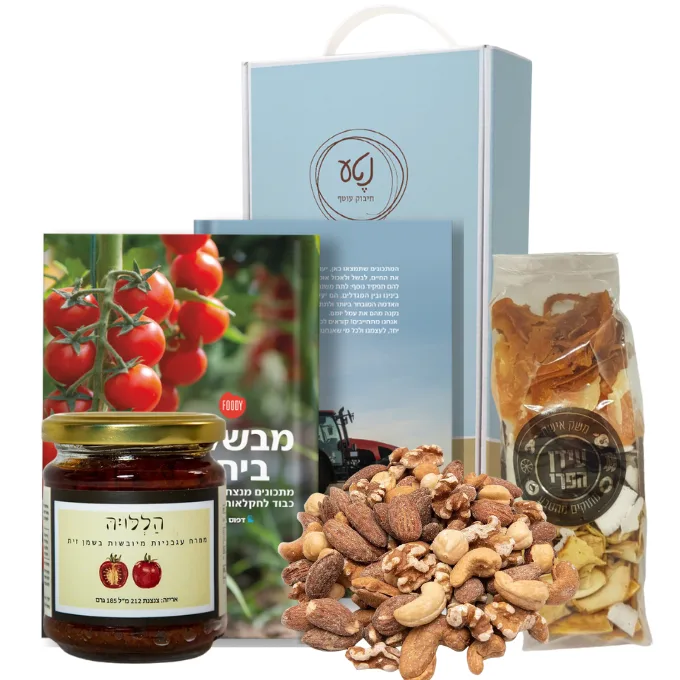
When you buy products from Kibbutz Be'eri and Erez, you are not sending an ordinary gift — you are routing money directly to two Gaza-Envelope communities that were on the front line on October 7, 2023 and that are still rebuilding today. Hibuk Otef curates their goods into kosher gift boxes that ship anywhere in Israel, each one carrying printed work from Be'eri's historic printing house and produce from the farms and apiaries around it. If you are wondering where to buy Israeli gifts that support real producers, this is the most direct route: a purchase, not a donation, with 60% of revenue going straight to the makers.
Hibuk Otef — The Story Behind Every Gift
Hibuk Otef (“Enveloping Embrace”) is a unique boutique gift initiative that brings together products from the communities of the Gaza Envelope and Israel’s southern and northern frontier, alongside works of art that commemorate the beauty of the region. The project was founded to support local producers, farmers and entrepreneurs who were affected. 60% of revenues go directly to producers from the affected communities.
Why Kibbutz Be'eri and Erez Still Need Buyers in 2026
Almost three years after October 7, roughly 700 Be'eri members are still living in temporary housing at Kibbutz Hatzerim, about 43 kilometers away in the Negev. Construction of the rebuilt kibbutz is targeted for completion at the end of 2026, with the bulk of families expected home in early 2027 — which means 2026 is the year the community is paying to rebuild while a large share of its people are still displaced. Be'eri lost more than 100 residents on October 7. Kibbutz Erez, roughly one kilometer from the Erez Crossing, saw its fields and hives shut down for months.
Both communities chose to keep producing rather than wait. That is why buying beats donating here: a purchase respects their dignity, the people who made the goods are paid for their work, and the income is recurring rather than a one-off. When you send gifts that support October 7 survivors, you convert a gesture of solidarity into a paycheck. Every box also carries a card naming exactly which communities your gift supports.
What You Can Buy From Kibbutz Be'eri
Kibbutz Be'eri's economic engine is the Be'eri Printing Press — founded in 1950, the largest print house in Israel, with around 400 employees including roughly 150 kibbutz members. It employs about 40% of the kibbutz's workforce and generates close to 90% of its revenue, printing for some of Israel's biggest banks, insurers and telecom companies. On October 7 the kibbutz was devastated; the press was back in operation in under ten days. “The print house is the heart of our community,” the company's chief marketing officer told reporters — “we fought hard to hold our heads up and keep working despite the loss we experienced.”
From Be'eri you can buy greeting cards, framed art prints, printed canvas bags, and original recipe books edited by women of the Envelope communities. The one that appears most often in Hibuk Otef boxes is “Cooking Together” (מבשלים יחד) — a 72-page softcover published by the Be'eri press that honors the farmers of the Envelope. Dropping it into a food gift is what turns a hamper into something that stays on a shelf: a quiet statement that says “we are still here.”
Erez Apiary Honey — Kosher Honey From the Border
The Erez apiary, established in 1950, is one of Israel's oldest and produces roughly 30 tons of honey a year at Kibbutz Erez, about one kilometer from the Gaza border. Its honey carries a deep floral aroma drawn from Negev and Mediterranean blossom, and the apiary was practicing sustainable, disease-free hive management long before the term became fashionable. After October 7 the fields were closed and the hives paused; once access was restored the beekeepers brought the hives back into regular management and resumed production.
Honey is also the single most requested item in a Rosh Hashana gift, which makes an Erez jar both symbolically right and commercially useful to the community that harvests it. If honey is your focus, see our guide to Israeli honey that supports farmers — buying it directly channels income back to the people who keep the hives.
Choose by Budget: Five Boxes From ₪71 to ₪212
Every box below is kosher, in stock, ready to send, and priced with 18% Israeli VAT included — the number you see is the number you pay, with no import charges added later. Prices run from ₪71 to ₪212 (roughly $24–$72 at the mid-August 2026 rate of about ₪2.96 to the dollar), and you can order any quantity: a single box or several hundred.
Liraz “Small Gesture” Box — ₪71 (~$24)
The connection to Be'eri and Erez: the entry-level way into Envelope-region gifting. The box holds a premium fruit confiture with no added sugar, 250g of Israeli honey from the Upper Galilee hills, and two packs of date-and-nut snack bites made by Tiv'it–BARBARY in Ashkelon — a city that absorbed rocket fire throughout the war. See the Liraz box
Shira Box — ₪112 (~$38)
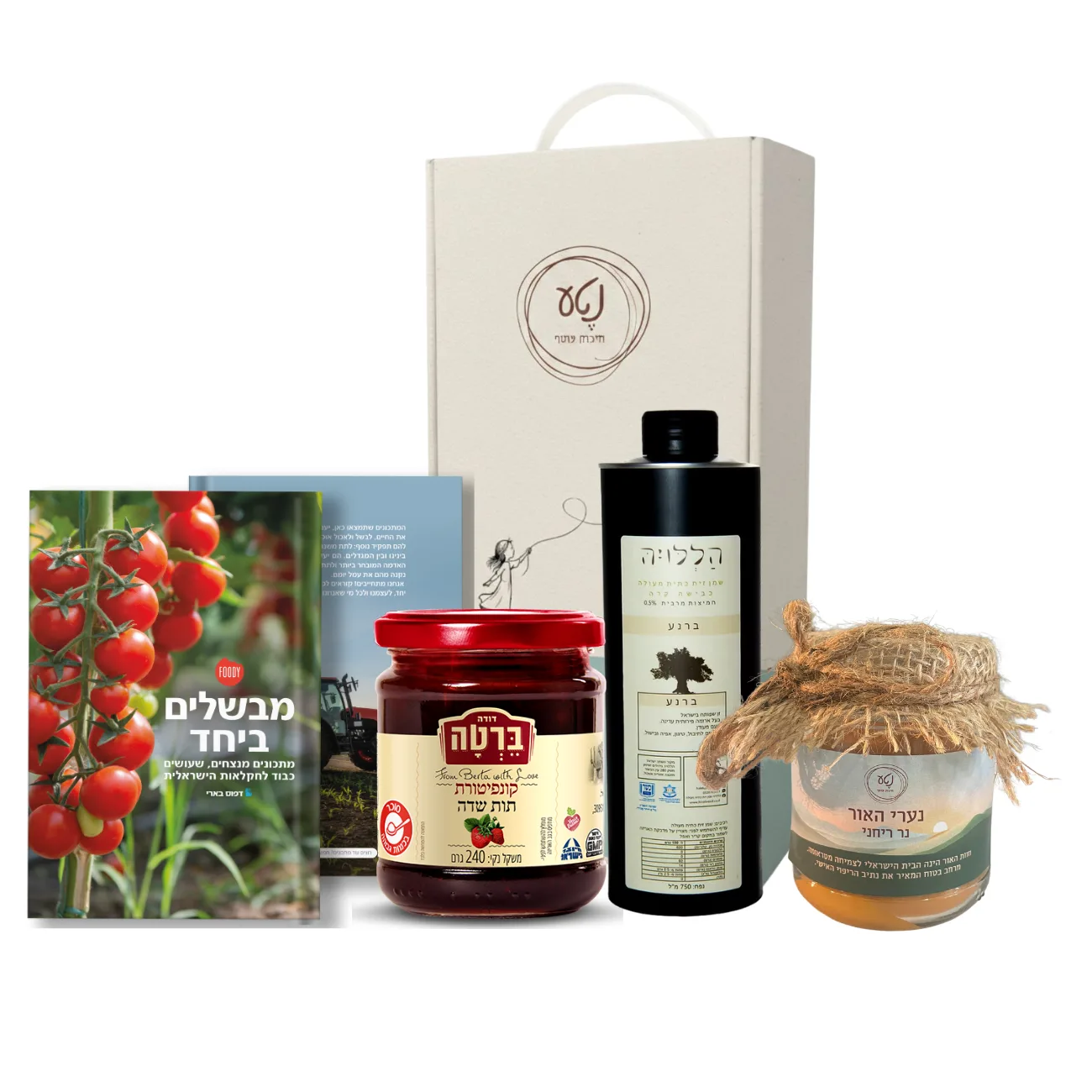
The connection to Be'eri and Erez: this is the most directly Be'eri box we sell. Inside: the “Cooking Together” recipe book printed by the Be'eri Printing Press, an aromatic “Na'arei HaOr” candle poured into glass with a jute cover (each one includes a contribution to a trauma-recovery farm in Rishpon), cold-pressed extra-virgin olive oil from Envelope groves, and a preservative-free fruit confiture. View the Shira gift box
Ma'ayan Box — ₪124 (~$42)
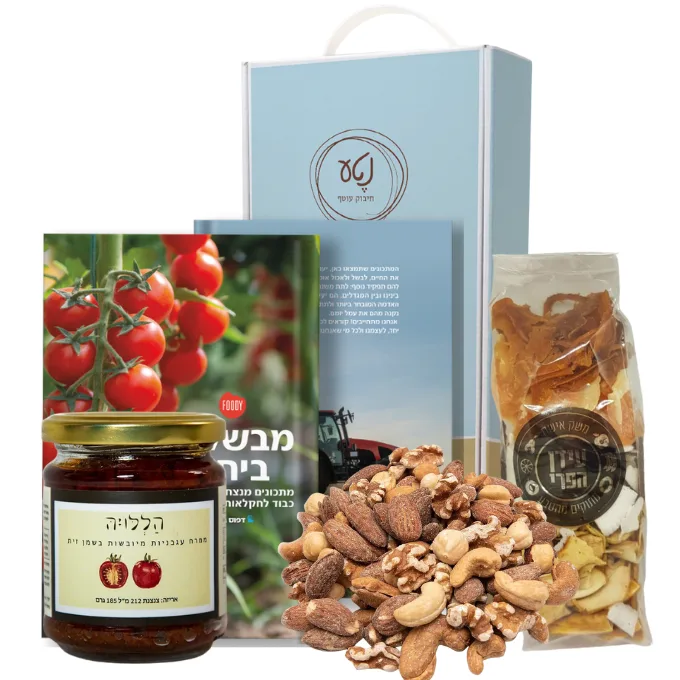
The connection to Be'eri and Erez: print plus produce, both from the south. It pairs 100g of slow-dried Upper Galilee fruit (persimmon, nectarine, banana, orange, plum, apple — no preservatives, no added sugar) with a 200g roasted nut mix from Netivot, and the Be'eri-published “Cooking Together” recipe book. Browse the Ma'ayan box
Hadar “All the Best of Israel” Box — ₪142 (~$48)
The connection to Be'eri and Erez: the crowd-pleaser for a family or a team, built around Israeli honey. It carries a 250ml bottle of natural-fruit limoncello liqueur, an 80g handmade premium chocolate bar, a 200g roasted mix of pecan, pistachio, almond, hazelnut and cashew, 250g of Upper Galilee honey, and BARBARY's no-added-sugar date-and-nut bites. Open the Hadar box
“All the Good From the South” Box — ₪212 (~$72)
The connection to Be'eri and Erez: our flagship Gaza-Envelope box, and the one where the largest absolute sum reaches southern producers. Inside a 26×35×10cm designed box: a 700ml lemon or pomegranate liqueur with a natural fruit base, 250ml of cold-pressed extra-virgin Israeli olive oil, a 185g preservative-free savory spread (sun-dried tomato, artichoke, roasted peppers or black-olive tapenade), a 240g premium fruit confiture, and a mix of Israeli dried fruit from Upper Galilee orchards. See the All-the-Good-From-the-South box
When to Order for Rosh Hashana 2026
Rosh Hashana 5787 begins at sundown on Friday, 11 September 2026 and runs through nightfall on Sunday, 13 September — an unusually tight setup, because the holiday runs straight into Shabbat and closes three consecutive days. Note that several gift sites list Rosh Hashana 2026 as 21 September; that date is Yom Kippur, not the New Year, and ordering to it will make your gift arrive nine days late.
Working backwards from 11 September, here are the dates that matter:
- Wednesday, 9 September 2026 — the last realistic delivery day anywhere in Israel before the holiday.
- Sunday, 30 August 2026 — order by this date for a standard single-address delivery, allowing about seven business days.
- Wednesday, 26 August 2026 — order by this date for a multi-address corporate list, where each package is routed separately.
- 1–9 September 2026 — the only clean delivery window of the entire Tishrei season. After Rosh Hashana come Yom Kippur (20–21 September) and Sukkot (25 September–2 October), which leave 22 non-working days across three holidays.
If you are coordinating a larger list, our Rosh Hashana 2026 sending guide walks through quantities, branding and address collection.
Sending From Abroad: Customs, VAT and Why Nothing Crosses a Border
The single biggest advantage of buying Be'eri and Erez products from an Israeli seller is that no package clears customs at all. Your box is assembled in Israel and delivered inside Israel, so there is no import declaration, no broker fee, no VAT recalculation on arrival, and no risk of the recipient being asked to pay before they can collect their gift.
That matters more in 2026 than it did last year. Israel's VAT exemption threshold for personal imports was raised to $150 at the start of 2026 and then restored to $75 effective 2 June 2026 — so a parcel shipped in from abroad and valued between $75 and $500 is now exempt from customs duty but liable for 18% VAT, payable by the person receiving it. A $120 hamper mailed from New York can therefore land your friend in Haifa with a bill of roughly $22 plus handling before the box is released.
Buying locally sidesteps all of it: the ₪71–₪212 prices above already include Israeli VAT, and the recipient pays nothing. For companies sending to Israeli staff or clients, the same logic applies at scale — see our B2B guide to client gifts sent to Israel from abroad for the deduction ceilings and invoicing details.
The Producers Behind These Boxes
Every item is traceable to a named maker — that is the difference between a Hibuk Otef box and a generic hamper.
The Be'eri Printing Press (Kibbutz Be'eri, est. 1950) prints the greeting cards, framed art, canvas bags and the “Cooking Together” recipe book that appears in the Shira and Ma'ayan boxes. Its banner after October 7 read: “despite everything, we must keep printing.”
Erez Apiary (Kibbutz Erez, est. 1950) works about a kilometer from the border and produces roughly 30 tons of honey a year in designed jars that carry the scent of southern blossom.
Tiv'it–BARBARY (Ashkelon, est. 2001) makes the date-and-nut bites in the Liraz and Hadar boxes. After two years of development the company launched its own brand from the southern industrial park of a city under rocket fire; the bars are at least 70% fruit and nuts, with no added sugar, gluten-free, vegan and parve, produced under ISO 9001:2015 and FSSC 22000 food-safety certification. The Medjool dates come from the Arava.
Beitan HaBad Karmei Negev (Moshav Yoshivia, Gaza Envelope, est. 2004) presses the cold-extraction olive oil in the Shira and southern boxes. During the 2023 harvest — with rockets falling — Shmuel Beitan's team refused to stop picking. The oil has since won national quality awards.
Francesca's Market in Gilat, founded by Efrat Monsterski, makes the small-batch spreads and jams: “born from a longing for the flavors we dreamed of.” She used the war as a reason to expand rather than close. Read more in our profiles of the people behind the boxes. Naming them is the point — your purchase is a paycheck with a face attached.
Frequently Asked Questions
Are the gift boxes kosher?
Yes — every box is kosher under local rabbinate supervision, and most carry Badatz certification. We can also match specific kosher requirements on request.
Is there a minimum order?
No. You can order any quantity — a single box or hundreds. For business orders we tailor a quote to your quantity, budget and box type.
When is the last day to order for Rosh Hashana 2026?
Order by Sunday 30 August 2026 for a single address, or by Wednesday 26 August 2026 for a multi-address corporate list. Rosh Hashana begins the evening of Friday 11 September 2026, and 9 September is the last realistic delivery day.
Will the recipient in Israel have to pay customs or VAT?
No. Boxes are assembled and delivered inside Israel, so nothing clears customs and the recipient pays nothing. The listed prices already include 18% Israeli VAT.
How much of my payment reaches the communities?
60% of revenue goes directly to producers from the affected communities. The remainder covers the product itself, packaging, the art card and delivery.
How to Order
Ordering is simple and personal. Browse the boxes on our website, send a message on WhatsApp at 054-2207955, or email us at netalc24@gmail.com. Tell us your budget, the occasion and how many boxes you need, and we'll tailor a quote — including branding, personal cards, and delivery anywhere in Israel or abroad.
Written by Neta Lin Cohen — founder of Hibuk Otef, architect and Bezalel graduate, with 30+ years of experience in culinary gifting.