Where Your Money Goes - The 60% to Producers Model (2026)
When you buy a Hibuk Otef gift, 60% of the revenue goes directly to producers from the affected communities in Israel's south and north. This page shows exactly where your money goes, what the remaining 40% pays for, and how to check the claim yourself — because a fixed share of revenue is a very different promise from the vague "proceeds donated" you will see almost everywhere else. If you are still comparing sellers, start with our guide to buying Israeli gifts that support real producers.
Hibuk Otef — The Story Behind Every Gift
Hibuk Otef ("Enveloping Embrace") is a unique boutique gift initiative that brings together products from the communities of the Gaza Envelope and Israel's southern and northern frontier, alongside works of art that commemorate the beauty of the region. The project was founded to support local producers, farmers and entrepreneurs who were affected. 60% of revenues go directly to producers from the affected communities.
What the 60% Covers — and What the Other 40% Pays For
Sixty percent of the revenue on every order — not 60% of profit, and not 60% of "proceeds" — is paid to the small farmers, food-makers and artists who supplied the contents of your box. On a ₪94 gift (about $32), that is roughly ₪56 reaching producers in the Gaza Envelope, the Upper Galilee and the Golan. The remaining 40% is not margin sitting in a drawer: it covers the designed box itself, food-safe packaging, the Bezalel art card, picking and packing, and delivery anywhere in Israel. Prices on this page include Israel's 18% VAT, so the number you see is the number you pay, and an Israeli recipient is never asked for customs or import charges at the door. There is no minimum order — a single box carries the same 60% commitment as an order of three hundred.
Revenue or "Proceeds"? The Word Changes the Math
"Proceeds" and "revenue" are not synonyms, and the gap between them is where most cause-marketing claims quietly disappear. Revenue is what the customer actually paid. Proceeds — as the term is normally used — is what remains after the business subtracts its costs, which means a headline like "10% of proceeds" can resolve to almost nothing once packaging, shipping, salaries and overhead are deducted first. That is precisely why several US states with commercial co-venture statutes require a seller to disclose the actual per-unit amount or percentage in its advertising rather than gesture at "a portion." A percentage of revenue can be checked against a price tag. A percentage of proceeds can only be checked against a ledger you will never see. When a gift cannot tell you which of the two it means, treat the claim as marketing rather than measurable impact.
How to Check Any "Gives Back" Gift in Two Minutes
Four questions separate a verifiable impact claim from a slogan, and you can ask all of them before you reach checkout. First: is the share taken from revenue or from profit/proceeds? If the page will not say, assume profit. Second: is there a number at all, or only words like "all proceeds," "a portion," or "supporting"? Third: are the beneficiaries named as specific businesses or people, or described only as a category such as "affected communities"? Fourth: does anything arrive with the gift that lets the recipient verify the story independently? It is worth being a little sceptical of yourself here, too: a 2011 study by marketing professor Aradna Krishna at the University of Michigan's Ross School found that people who bought cause-marketing products afterwards gave less in direct donations than those who had not — so a purchase is best understood as a purchase that pays someone fairly, not as a substitute for giving.
Proof That Travels With the Box
Every Hibuk Otef box ships with a printed card that explains the project and names the producers inside it, so the person unwrapping the gift can see whose work they are holding rather than taking the sender's word for it. That matters because the recipient, not the buyer, is the one who meets the product. The card is also the reason the model survives contact with a corporate order: a company sending two hundred boxes can point to a defined revenue share and a named list of suppliers when it writes up the social impact of the spend, instead of citing an unquantified donation. You can read the individual stories behind the names in our profiles of the people behind the boxes.
Choose by Budget — Three Boxes, One Commitment
Every box below is kosher, in stock, priced with 18% VAT included, and available in any quantity, from one to several hundred. Dollar figures are approximate, at roughly ₪2.98 to the dollar. The 60% share applies identically at every price point — a ₪71 box is not a lesser version of the promise.
1. Naama "Small Gesture" Box — ₪71 (~$24)
The connection to where your money goes: the lowest-priced way to put real revenue into producers' hands, and the box that proves the model does not need a large order to work. Inside a 10×35×10cm designed box: an 80g handmade premium chocolate bar (dark with candied pecan, or milk with hazelnut pieces), a 240g preservative-free fruit confiture (blueberry, apple-and-cinnamon or pomegranate), and a 55g pack of date, nut and fruit snack bars with no added sugar. View the Naama box
2. Yarden Box — ₪94 (~$32)
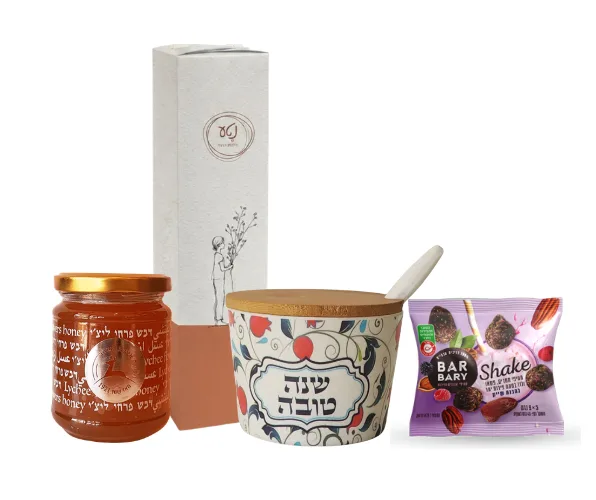
The connection to where your money goes: this is the box where you can literally see the art half of the model. It holds a designed acrylic honey vessel with a cork lid and spoon — created by two women artists of Studio Dugma in the Gaza Envelope — alongside a 200g jar of fine Israeli honey from the Upper Galilee hills and a 45g pack of no-added-sugar date and nut bars in fruit flavours. Two separate producers, one region each, both paid from the same 60%. View the Yarden box
3. Udi Box — ₪148 (~$50)
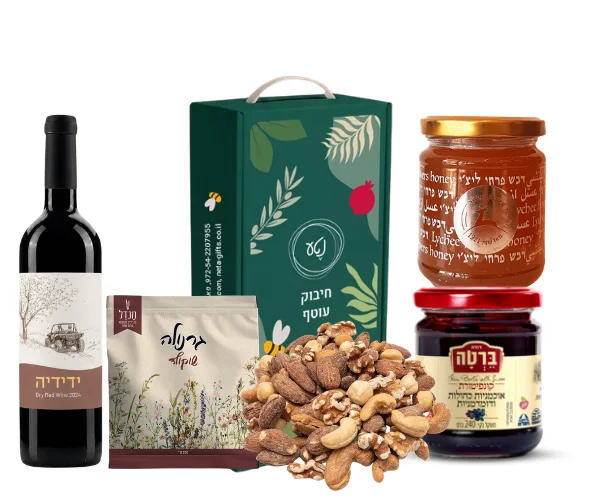
The connection to where your money goes: the box that carries a second, separate act of support on top of the 60%. Inside an 18×35×10cm box: a 750ml bottle of dry boutique red wine, "Yedidiya," from Cabernet and Syrah grapes by Tishbi Winery — named for Yedidiya Bloch, who fell in the war in Lebanon, and sold with a contribution to his reserve paratrooper company's support and commemoration fund — plus 250g of Upper Galilee honey and a 240g preservative-free fruit confiture. View the Udi box
Sending a larger list, or ordering from abroad? Our complete guide to sending a gift basket to Israel covers delivery windows, branding and address collection.
The Producers Behind These Boxes
A percentage only means something once you can name the people on the receiving end.
Studio Dugma (Gaza Envelope) is the two-artist studio that designs and hand-decorates the acrylic and ceramic honey vessels in the Yarden box. Theirs is the clearest example of why the art side of the project exists: the vessel outlives the honey, so the gift keeps its origin visible on a shelf long after the food is gone.
Tishbi Winery (Zichron Ya'akov) produces the "Yedidiya" boutique red in the Udi box, a memorial bottling for a soldier who fell in Lebanon. It is the one item in this range whose story is commemorative rather than agricultural — and it is included precisely because buyers ask what a bottle is for, not only where it is from.
Dekarina (Golan Heights) is among the northern chocolate makers whose handmade bars go into the Naama box. The Golan and Upper Galilee spent long stretches of the Lebanon war under fire and evacuation orders, and northern producers are consistently the ones left out of "support Israel" gifting that stops at the southern border. You can see how the south-and-north split works in practice in our guide to gifts that support Israeli farmers.
Frequently Asked Questions
How much of my purchase reaches the producers?
60% of revenue goes directly to producers from the affected communities. The remaining 40% covers the product, the packaging, the art card and delivery. The share is calculated on what you pay, not on profit left over after costs.
Is this a donation or a purchase?
It is a purchase. You receive a real, kosher gift, and the producer is paid for their product rather than given aid — which sustains a working business far better, and far longer, than a one-time donation does.
How is this different from "a portion of proceeds"?
"Proceeds" usually means what is left after a business covers its costs, so the final figure can be very small and is impossible for a customer to audit. A fixed 60% of revenue is anchored to the price on the page, which means you can do the arithmetic yourself.
Can my company use this for impact reporting?
Yes. A defined revenue share plus a named list of suppliers gives you something concrete to document, which is what most CSR and procurement teams need. Tell us your quantity and budget and we will prepare a quote and the supporting detail.
Are the products kosher?
Yes — kosher under local rabbinate supervision, most Badatz. We can also match specific kashrut requirements on request.
How to Order
Ordering is simple and personal. Browse the boxes on our website, message us on WhatsApp at 054-2207955, or email netalc24@gmail.com. Tell us the occasion, your budget and how many boxes you need, and we will tailor a quote — including branding, personal cards and delivery anywhere in Israel.
Written by Neta Lin Cohen — founder of Hibuk Otef, architect and Bezalel graduate, with 30+ years of experience in culinary gifting.